Southland Tales (or, "How I learned to accept the impending collapse of America")
- Will Prososki
- Jul 4, 2022
- 5 min read

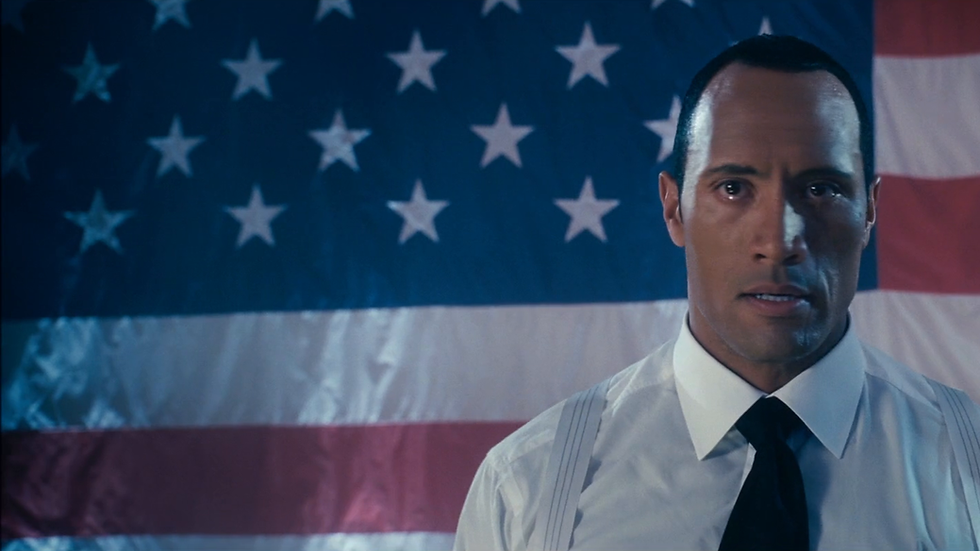
Richard Kelly’s 2006 film Southland Tales is a fundamentally broken movie. It’s an incomplete story, the second half of a story to be specific, front-loaded with expository narration in order to catch up the viewer on the tons upon tons of world building and lore that would’ve needed an entire movie to fully explore, kneecapping the movie’s structure and pacing. It’s a hodge-podge of vague political statements, commentary on post-9/11 American paranoia, pop culture satire, and apocalyptic science-fiction concepts that leads to an end result that is narratively confounding at best and incomprehensible at worst.
And honestly, I kind of love it.
I guess the best way to start with talking about this movie is to first give my interpretation about what this film is trying to do, with emphasis on the word “trying.”
The movie stars Dwayne Johnson as an actor having a nervous breakdown after losing his memory, Seann William Scott playing two versions of the same cop, Sarah Michelle Gellar as a porn star with ties to a movement trying to steal an election, and Justin Timberlake as a drug dealing veteran who sits around spouting expository narration and lip syncing The Killers.
It’s almost pointless trying to run through the plot of this film, but instead about what it’s trying to say. Again, emphasis on “trying”.
Southland Tales is about how every aspect of American culture, from rampant nationalism and blind patriotism, obsession with celebrity and pop culture, the consolidation of corporate and political power, endless wars for natural resources, and a willingness to sacrifice its own citizens and veterans for corporate financial gain, police brutality, the acceptance of The Patriot Act, basically everything that could be said about post-9/11 America is said somewhere in Southland Tales.
The first spoken line of Southland Tales is “This is the way the world ends.” This is the thesis statement that Richard Kelly is operating on with this film; that every facet and aspect of American culture in the 21st century creates an interconnected web that will inevitably lead to the apocalypse. Where he fails, however, despite repeating the line “this is the way the world ends” many, many, MANY, times throughout the 2 hr 40 minute runtime is to show how any of the myriad of moving parts in the extremely complex political game at play comes together or works off each other.
All of the ingredients for a science fiction epic like The Matrix Trilogy combined with a piece of dark political satire like Terry Gilliam’s Brazil or Kubrick’s Dr. Strangelove, right down to having an identical ending to the latter, but what should feel like an intricate, well-oiled machine where each piece moves into the other like clockwork, feels more like a pile of parts from a bunch of different machines jammed together into a mess of parts that don’t go together at all.
The end product is something that feels like a Matrix-sequels-amount of lore crammed into something with as many characters and plotlines as Magnolia, with even more attempts at Paul Verhoeven-esque political commentary than it has time to properly expand upon. The science fiction elements fall flat because they are never properly explored, the plot falls flat because it has no focus and redirects itself every 20 minutes, and the political commentary falls flat because it is trying to say so much without really having anything to actually say about any of it.
So why do I like it so much despite it being undeniably a bad movie?
What separates Southland Tales from other failed commentaries on 21st Century American culture such as Crash (not the cool one by David Cronenberg), which was closer to the time period in which Richard Kelly was constructing Southland Tales, and a more recent example, Adam McKay’s Don’t Look Up?
Where Crash is completely misguided and horribly aged after 20 years, feeling closer to something released in 1954 than 2004, and Don’t Look Up takes a cynical, self-righteous approach to its commentary on modern American cultural discourse that comes across more obnoxious than anything else, Southland Tales is nothing but pure, weird ambition through the roof. Misguided ambition, sure, but there is not a trace of self-righteousness, cynicism or anything of the sort to be found in Southland Tales that makes Don’t Look Up so insufferable.
The internet and social media has allowed us to see the scale of our nation's mistakes, cruelty, and hypocrisy in real time in a way that had never been possible before. We can see how the tangled web of fuck-ups over the past 50 years are an intricate trail of breadcrumbs that have led us to where we are now.
Perhaps Southland Tales is such a mess because it was made about the Bush era during the Bush era and not with the amount of retrospective knowledge about the era that we have nowadays. Or maybe it’s just because it was structured in a ridiculous, incomprehensible way that someone should’ve told Kelly was a stupid way to make a movie. Who can really be sure?
However, maybe because in 2022, it is a lot easier to see the point that Richard Kelly was trying to make with this movie than it was in the Bush era, as well as see exactly what makes. In retrospect, and with the internet, it’s easy to see the web of long-term policy and psychological effects of 9/11 and The Patriot Act on American culture, white supremacy, the drug epidemic, the Bush era and how it led to Obama and how the Obama presidency led to the Trump presidency and how an incompetent Democrat party held the door open for right-wing Christian extremism in government.
Given the amount of information at our fingertips at any given moment, coupled with the state of America, most Americans can see that the country that they’ve been told their entire lives is the gold standard of democracy, is crumbling around them before their eyes. Now, even more in the mid-2000s, with the impending climate apocalypse, opioid epidemic, a pandemic that has killed millions, rights being stripped away, rise in the popularity of right-wing extremism, and the role that income inequality plays in all of it, and our governments inaction on every once of those problems, the end of The United States of America seems more inevitable than ever. It’s cathartic to watch something like Southland Tales, as clunky as it is, that seems aware of that and the consequences that will inevitably follow.
While it would be cool if a movie with the same concepts Southland Tales tackles was as good as Brazil or Dr. Strangelove, or something like The Boys, which tackles a lot of the same ideas just in a longer form medium, it’s almost more interesting when it is this much of a complete mess.
Happy 4th of July, I cannot imagine there will be many more of them. This is the way the world ends.



Comments