Comparing and contrasting Soviet and American perspectives on World War II through film
- Will Prososki
- Feb 3, 2022
- 6 min read


Perspective is one of the most important keys to understanding the politics of a film. The perspective of the time and culture surrounding certain eras or subject matters drastically impacts the art that will be produced regarding said subject matters. A key example of this is how reverently American films treat World War II, and how films in the Soviet Union deals with World War II.
In the United States of America, our victory in World War II is seen by many as one of the nation’s greatest achievements. Not only was America essential in defeating one of modern history’s greatest, most universally despised threats, Nazi Germany, but the aftermath of the war saw many benefits. In wake of the war, the United States economy saw a boom like no other country in the world. The economic boom, on top of the fact that the war itself never reached American soil, gave many American citizens a positive outlook on the war that was almost exclusive to the United States. This outlook is based purely on the political perspective that America held at the time that has been perpetuated by the culture surrounding our nation’s actions in the war.
In the majority of American films from the 20th century all the way up to the 2010s regarding World War II, particularly ones revolving around the troops, have been patriotic in nature, painting the United States as the heroes of the war. America is the good guys, a force for good on a mission to liberate Europe and save the world from Nazism, Germany is the bad guys, and the good guys defeat the bad guys in the end. The black and white way that many Americans look at the conflict strips away the horrific nature of Nazism from the eyes of the American public. Even movies that are not explicitly about World War II often use Nazis as generic stand-in villains, such as Steven Spielberg’s Raiders of the Lost Ark, or John Landis’s The Blues Brothers. When the horrors of fascism are reduced to “they were the bad guys,” the examination of how ideologies like Nazism take hold in Germany in the first place is removed. This outlook on World War II has certainly warped many people’s idea of war, and the overwhelmingly patriotic way that American films have romanticized the United States’ actions in World War II has robbed many filmgoers of an awareness of the nuances that go into every war.
Steven Spielberg’s 1998 film Saving Private Ryan is regarded by critics and audiences as not only one of the best movies centered around war, but one of the finest films of all time in any genre. The film boasts an impressive 8.6/10 and is ranked #26 on the Top 250 Films of All Time List on IMDb, 4.2/5 from users on Letterboxd, and a 93% positive critical reception on Rotten Tomatoes. The film is praised for its portrayal of the battle at Omaha beach in the films first act, and for how realistically the violence of war is shown. Saving Private Ryan was released a few years after the 50th anniversary of the end of World War II, and in the aftermath of Americans becoming cynical in their attitude towards the government and military in the light of the disastrous Vietnam War, many Americans took solace in the heroic conception of the military during World War II. The film is very conscious of this, and instead of taking a darker, cynical look at the war, like how many films approach the Vietnam War, it takes an extremely nationalistic and almost feel-good approach to an extremely violent moment in world history.
Saving Private Ryan is centered around a team of soldiers on a mission to find and take home a single soldier, Private Ryan, since the Private’s brothers were all killed in various battles. The film’s American perspective of World War II is apparent right from the premise of the film. The United States is portrayed as an altruistic force for good, who out of the goodness of their hearts are willing to send a squad of soldiers to rescue one young man and send him home to his mother, who just received word that all three of her other sons have been killed. Despite the film’s dedication to realism on a technical level, from its cinematography, sets, sound design, costumes, and brutally realistic special effects, it is unable to untether itself from America’s overly fantasized and patriotic account of World War II.
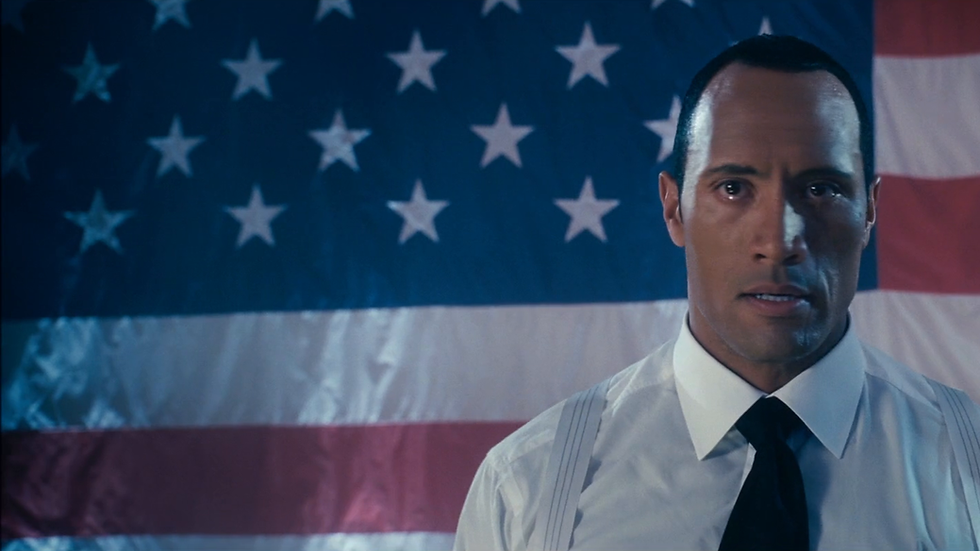
The film opens with imagery and music that is intended to evoke feelings of patriotism from its audience. The first shot of the film is an American flag basked in sunlight with a slow, borderline emotionally manipulative trumpet theme from John Williams, intended to replicate the sounds of a military march. The scene then shows an old man, who is later revealed to be an elderly Private Ryan, walking through a park with a confident stride, giving him an air of mystique as his family follows behind slowly, unsure of his destination, but understanding the importance. Ryan’s family looks at his with a mix of concerned, forlorn, and respect, one even snapping a picture of him from a distance as he walks. The shot of the flag, Ryan, and the shots of the family are meant to imply a feeling of patriotism, reverence and importance towards World War II veterans in the viewer. Ryan’s family shows respect for this moment, therefore so should the audience. As Ryan makes his way into a WWII cemetery, he stops in the entrance, and the scene cuts to another American flag as the slow trumpet theme continues. The flag is shown before the graves of American soldiers, implying the importance of the nation over the soldiers who died for it. Ryan then falls to his knees in front of a grave, before the scene transitions into the iconic Omaha Beach battle sequence, a nearly 30-minute long, extraordinarily realistic account of D-Day.
It is not hard to determine the intention behind Saving Private Ryan’s juxtaposition between the extremely graphic and realistic depictions of war with the romanticized, patriotic elements. Spielberg clearly wants to instill a feeling of respect for both veterans of WWII and those who died in the war, and an understanding of the horrors that were experienced, but the nationalistic elements make the film feel like it is cynically propagandizing these events for an audience that will never experience anything similar, more than it is accurately depicting the
Elem Klimov’s 1985 Soviet film Come and See is also an extremely well-regarded film about World War II, but its effectiveness comes from a completely different perspective on the war. Where the dark depictions of war in Saving Private Ryan are lightened by the film’s uplifting patriotic message, Come and See is unrelenting in showing the brutality of war, because the Soviet Union did not experience World War II in the same way that the United States did. The Soviets saw the war come directly to their doorstep, with roughly 9 million military deaths and 19 million civilian casualties. With such a massive death toll, an economic boom similar to the United States was impossible, and so was the same positive outlook on World War II. Nearly every facet of this film is designed to make the viewer feel the hopelessness of war that the citizens of the Soviet Union felt at the time of the war. As opposed to Saving Private Ryan, which portrays America as an honorable force for good, Come and See is simply about trying to survive the worst situations a person could possibly experience. Instead of an emotional score, throughout the film is a low droning score that creates an uncomfortable, eerie feeling. There is no patriotic bookend, or a veteran saluting the grave of the captain who rescued him. Come and See ends with a montage of the protagonist’s squadron in a state of perpetual war as seasons pass by, showing the unending, cyclical nature of war and its effects on those involved.
The dehumanizing nature of war is a central theme of Come and See, which is visually communicated by Flyora’s physical transformation as the movie progresses. At the beginning of the film, Flyora is an eager, optimistic boy who is excited for glory and wants to defend his village and defeat the threat against his home. He has bright eyes, a smile from ear to ear, and rosy cheeks. But as the film progresses, and he sees the harsh, terrifying atrocities and destruction inflicted upon Eastern Europe. His entire village gets murdered by Nazis, the friends he makes along his journey get either raped and beaten by a gang of soldiers, or blown up by airstrikes, and the town he takes sanctuary in gets burned to the ground, along with the town’s children. As Flyora learns the true nature of war, he physically becomes more decrepit. He starts the film as a bright-eyed young man, and by the end of the film, standing in the ruins of the Nazi’s company with his squadron, he looks like a worn down, tired old man.
The differences between how each nation perceived World War II based on the films produced about the subject can be seen overt ways, such as the differing plots, music and character arcs, but subtle ways, such as how films are titled. The title “Saving Private Ryan” implies heroism and honor, which is exactly how America views our country’s actions in World War II. The film wants the viewer to leave the film understanding horrors, but knowing it was all for a good cause. The title “Come and See” is an invitation to witness the destruction and heartbreak that the war inflicted upon millions of people, and the film does not allow the viewer to leave the film without understanding these horrors.


Comments